

Where the Planetary Endgame Will Be Won or Lost

Imagine this: it’s a prime-time evening in America, circa 1995, and three million people are watching their favorite show — maybe it’s Cheers or Murphy Brown. At station break, a batch of cosmetics and fashion ads come on featuring perfectly beautiful models peacocking down the runway. Then … POW! Cut to a ribby, bulimic Kate Moss-lookalike bent over the toilet puking her guts out. Our fifteen-second mindbomb ends with an outshot like the voice of God:
“The Beauty Industry is the Beast.”
What the fuck?!
America, you’ve been slimed.
That’s culture jamming, baby!
Ridiculous, yes. But is it any more ridiculous than what we were trying to disrupt? The passive acceptance of a one-way flow of marketing messages that tickle your id and sculpt your feelings and shape your values and dictate what you should do with your time and your energy, your politics and your dreams?
What I felt back then, a quarter-century ago, is what I still feel today: that one-way corporate mindfuck is approaching a level where a massive pushback is inevitable. An anti-corporate uprising will be the next great social movement of our time. The fact that three other major social movements leapfrogged it makes me more, not less, certain of its inevitability. The beauty and power of #OccupyWallStreet, #MeToo, and #BlackLivesMatter is that they’re training people to detect hidden patterns — to notice who’s being shafted. We don’t see logos, we don’t hear corporatese, we don’t feel overly angry about their total surveillance, or too let down when heinous criminals like Wells Fargo, Purdue and ExxonMobil walk free. We’re so far up the butt of America Inc. that we’re on the side of injustice without even realizing it.
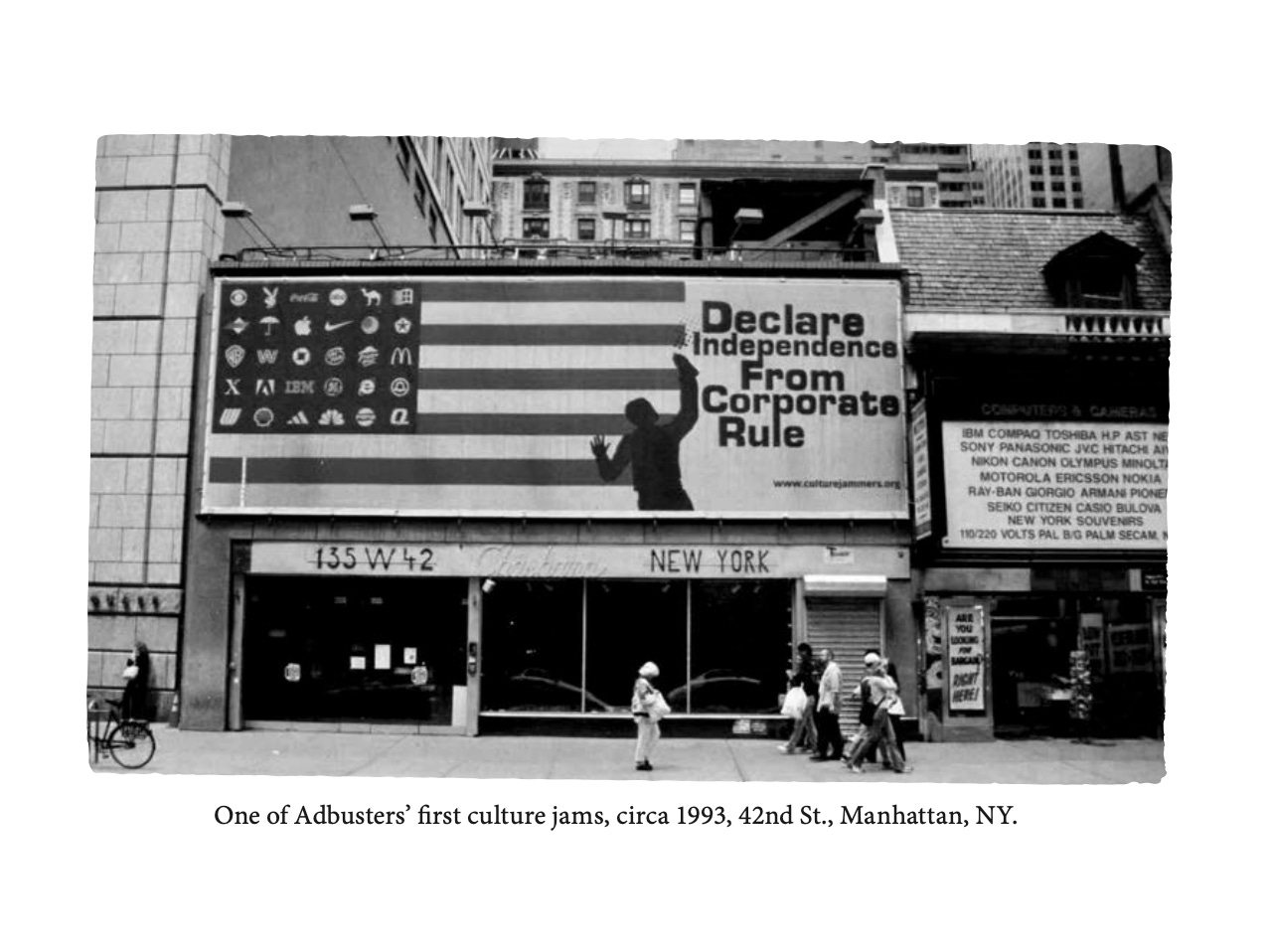
This was the work, then, back in the early days of Adbusters: to smash the commercial monopoly on the production of meaning. The first generation raised on television was mounting a resistance, pulling together a game plan on the fly.
We were inspired by how a handful of low-budget anti-smoking campaigns had toppled the billion-dollar PR might of Big Tobacco. Suddenly, on every cigarette pack, sickening pictures of diseased lungs. On TV, celebrity actor Yul Brynner, just before he died of lung cancer, looked you straight in the eye and said: “Whatever you do, don’t smoke!” These jams basically rewired our response to images of smoking — from seduction to revulsion. Now every time the Marlboro cowboy lit up, people winced. Philip Morris realized that every dime they spent on advertising was actually doing self-damage. So they stopped.
We were chuffed. A well-crafted, low-budget attack was all it took to bring these fuckers down. It isn’t about the size of your war chest; it’s about the condensed power of your message. Small and cunning beats rich and lumbering and on the wrong side of history. Our upstart “journal of the mental environment” had a chance. With deft judo-like moves we would throw mega-corporations to the mat with the power of their own misplaced momentum. We’d beat them at their own game.
If it could work on Big Tobacco — one of the biggest, baddest industries of all — we reckoned it could work across them all — food, fashion, automobiles, communications, finance. Every area of our lives where someone had broken in and shoved their swagger down our throats.
We decided to lead the charge. We’d detourn their logos, dick around with their ad campaigns, inflict brand damage and duke it out with them on TV. We’d neutralize the cultural power these corporations had claimed as their own. McDonald’s, Absolut, Calvin Klein, Nike. None were too big to fall.
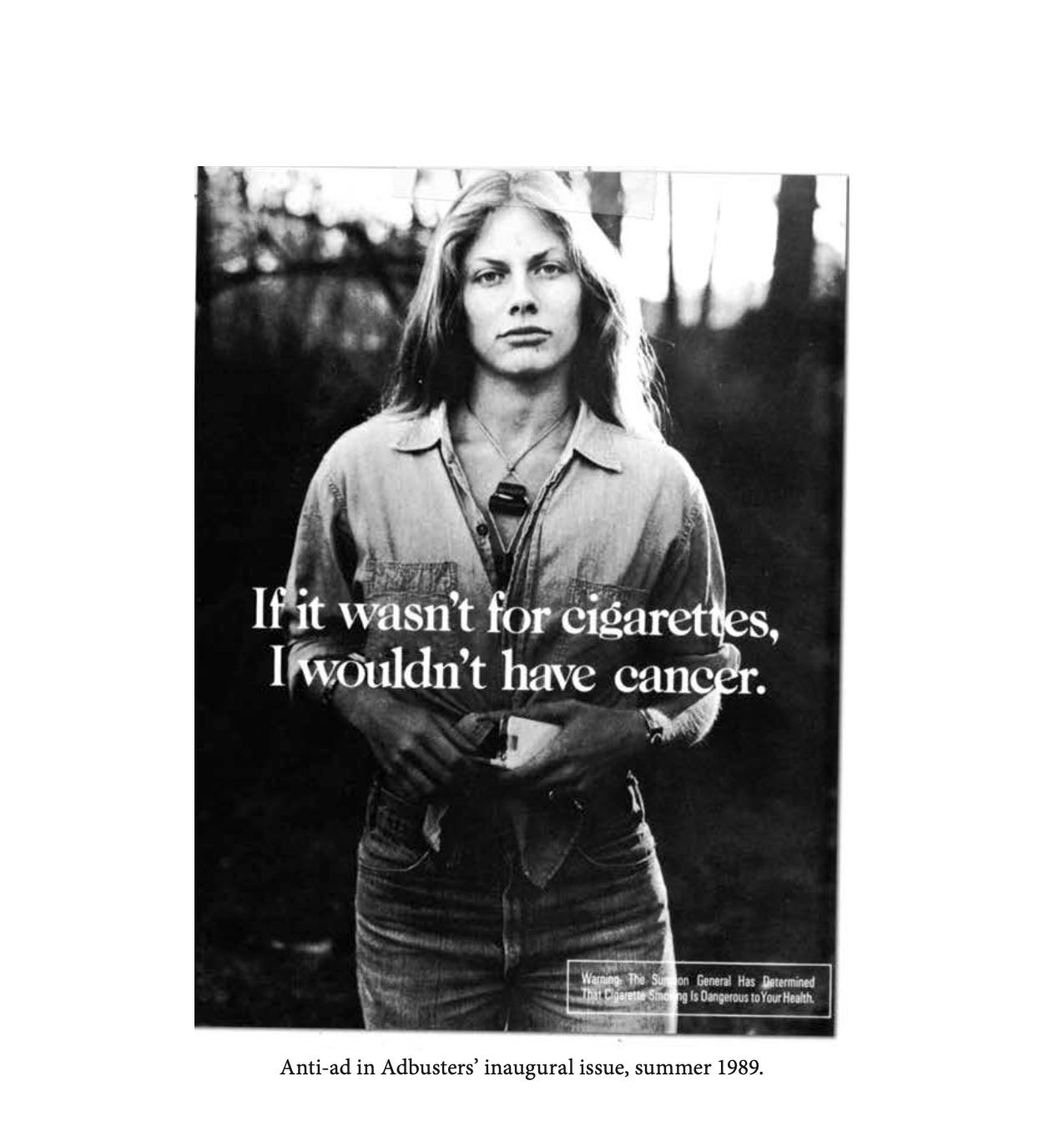
I was in full double-agent mode now. Every advertising trick I learned in Tokyo could be used in reverse. Instead of showcasing the client’s unique strength, we’d identify their unique vulnerability. We’d make folks understand — not intellectually but viscerally — what is fraudulent about their seductions.
Take Absolut Vodka. Their flood-the-zone PR strategy had them on the back covers of magazines on newsstands around the world. What’s the Achilles heel of Big Spirits? Same as Big Tobacco. It’s showing people what really happens when you use their product as directed. What alcohol’s actually about? Not the shining promise of turning you into a hilarious party animal who gets laid in the car, but brain-fog, impotence and puking on your shoes. Career suicide. Actual suicide. AA meetings. Death and suffering and humiliation: Make folks feel it.
A mindbomb delivered in a goodie bag. What was it Billy Wilder said? If you’re gonna tell the truth, you’d better be funny or they’ll kill you.
Absolut had a global print campaign centered on the shape of their bottles, and we countered with a riff on the same theme that got a lot of attention. It amused everyone but Absolut. They sent an international law firm with a cease-and-desist order.
This was actually pretty intimidating. They implied they could destroy us if we didn’t stop our spoofing campaign and of course they were right. Fear works on a power differential, and you never know how far they’re willing to go.
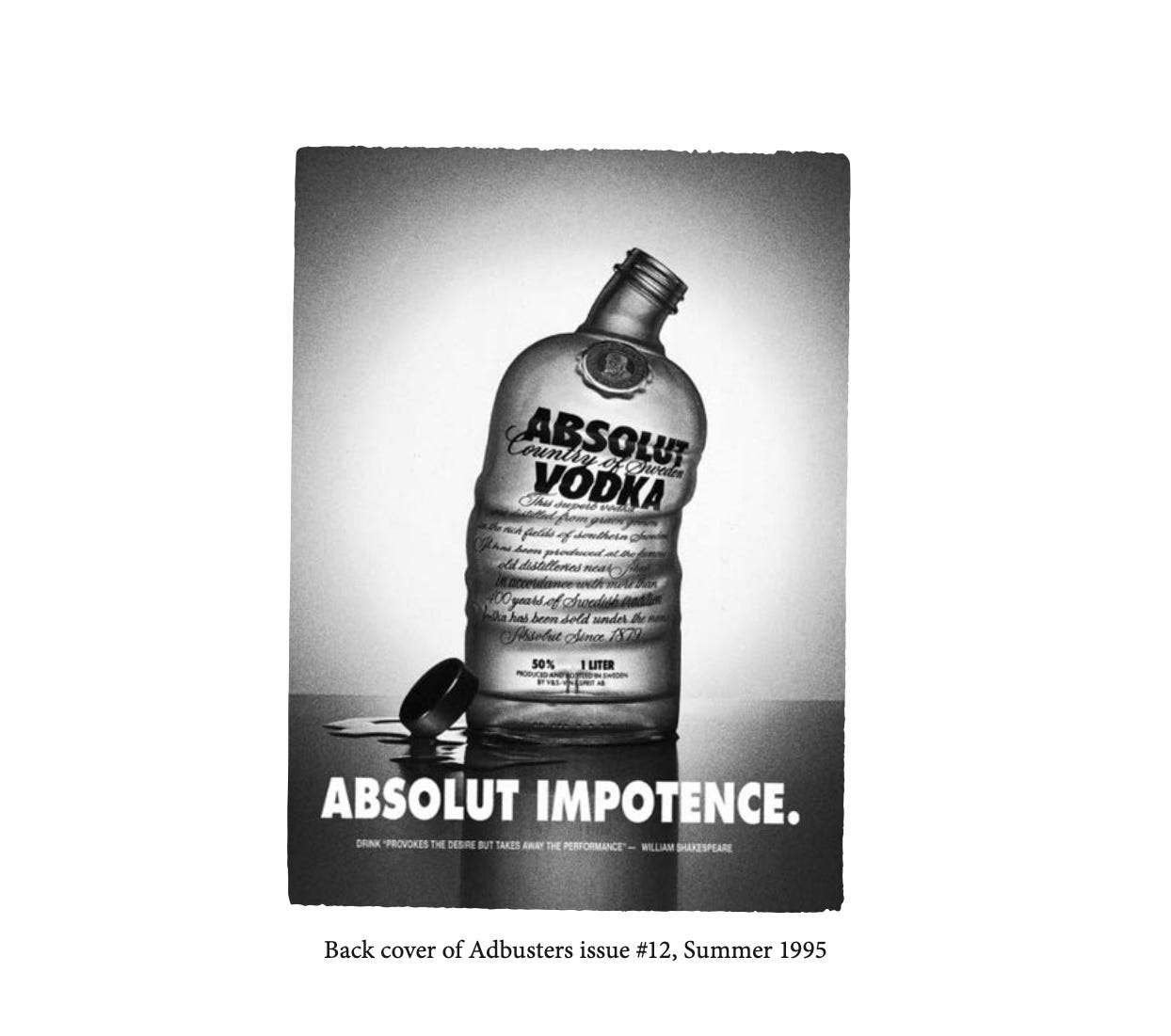
But then we fought back and the press got hold of the story. They picked up on the David-vs-Goliath angle. Suddenly the dynamic reversed. Absolut looked like a bully and they quickly backed off.
It was a delicious moment. Absolut had scared the hell out of us. But it became clear we had also scared the hell out of them. They knew we had the people behind us and could inflict severe brand damage.
When Absolut first came after us, we added an “e” to the word on our spoofs for legal protection; but when they pulled their lawsuit we exhaled, put the five-finger flag to our nose and took the “e” out again.
We could tell Nike CEO Phil Knight was rattled too when he got wind of a billboard spoof we were planning near the company’s HQ in Beaverton, Ore. Phil could not countenance the thought of an unswooshing message welcoming his employees as they drove to work in the morning.
So now here we were again, faced with another multinational bringing all its horses. But this time we knew better than to be intimidated. When reporters called us up, one minute we’re talking about Tiger Wood’s swooshy smile, and the next minute we’re talking about Indonesian sweatshop labor. The stories come out, Phil Knight looks like an asshole and his swoosh has lost a bit of its nuclear glow.
And I realized something. The wild, sledgehammer-on-a-fly overreaction of these multi-billion-dollar corporations exposes how fragile is this thing called cool. And how you can’t impose it on people. Real cool is a revolutionary impulse — a reaction to power. Top-down corporate cool is a fraudulent algorithm, and deep down the big guys know it. That’s why they’re scared. The emperor is buck naked. We the people rule!
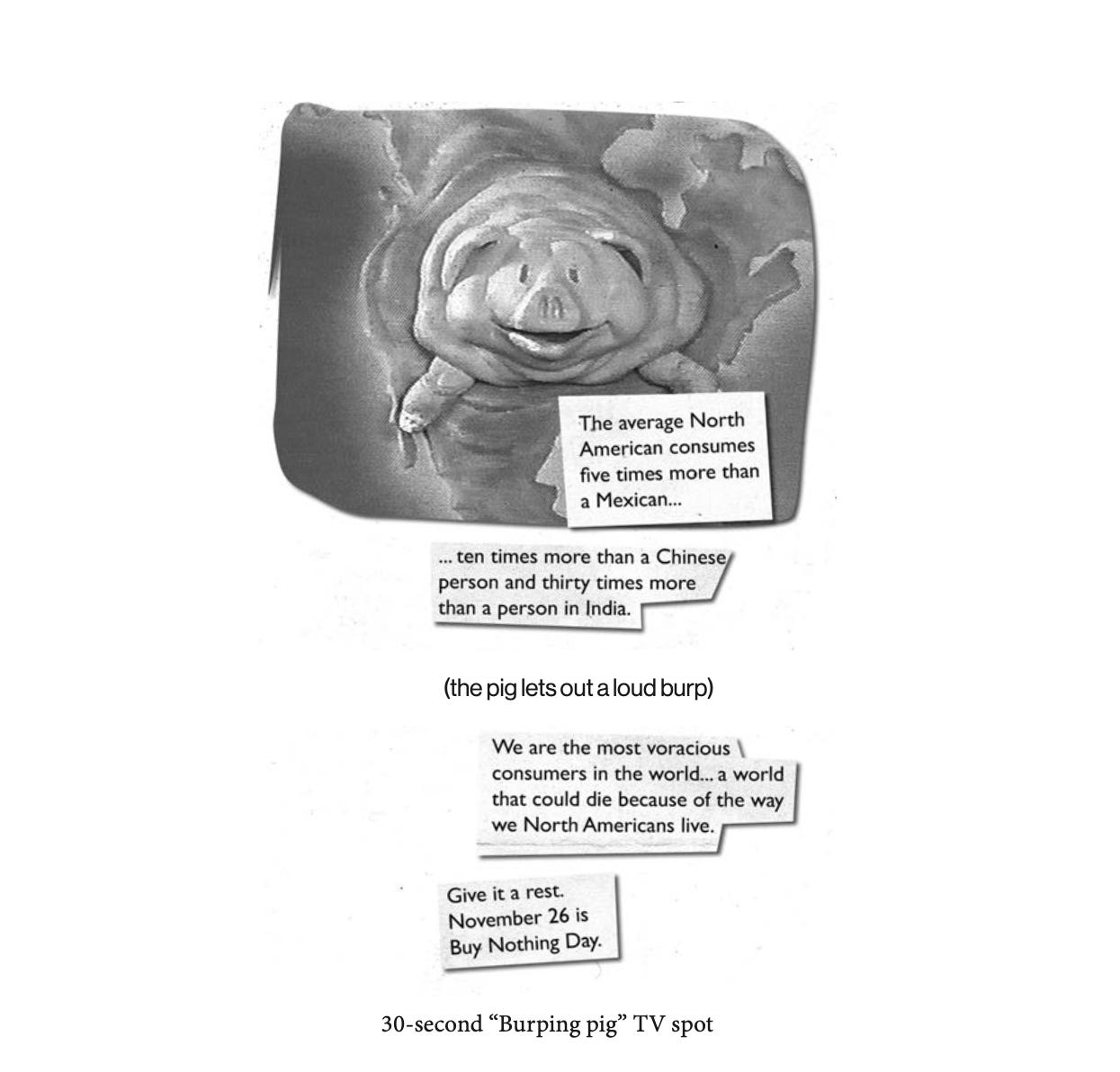
Buy Nothing Day was our first big success. The fledgling environmental movement was banging the drum that overconsumption was at the core of all our planetary woes, and we caught the zeitgeist. We produced a 30-second TV spot featuring a burping pig wallowing on a map of North America. The voice-over threw out some sobering figures about consumption levels and chided that “the world could die because of the way we North Americans live. Give it a rest, November 26 is Buy Nothing Day.”
The meme spread. Buy Nothing Days popped up in Vancouver, Seattle, San Francisco, Austin, New York. It jumped the ocean, to Sydney and Melbourne, then to London (where they called it No Shop Day). Within a few years, Buy Nothing Day was a yearly celebration of frugal living in more than 60 countries.
We learned that if you let loose a tantalizing meme at just the right cultural moment, it can hit the public imagination with incredible force.
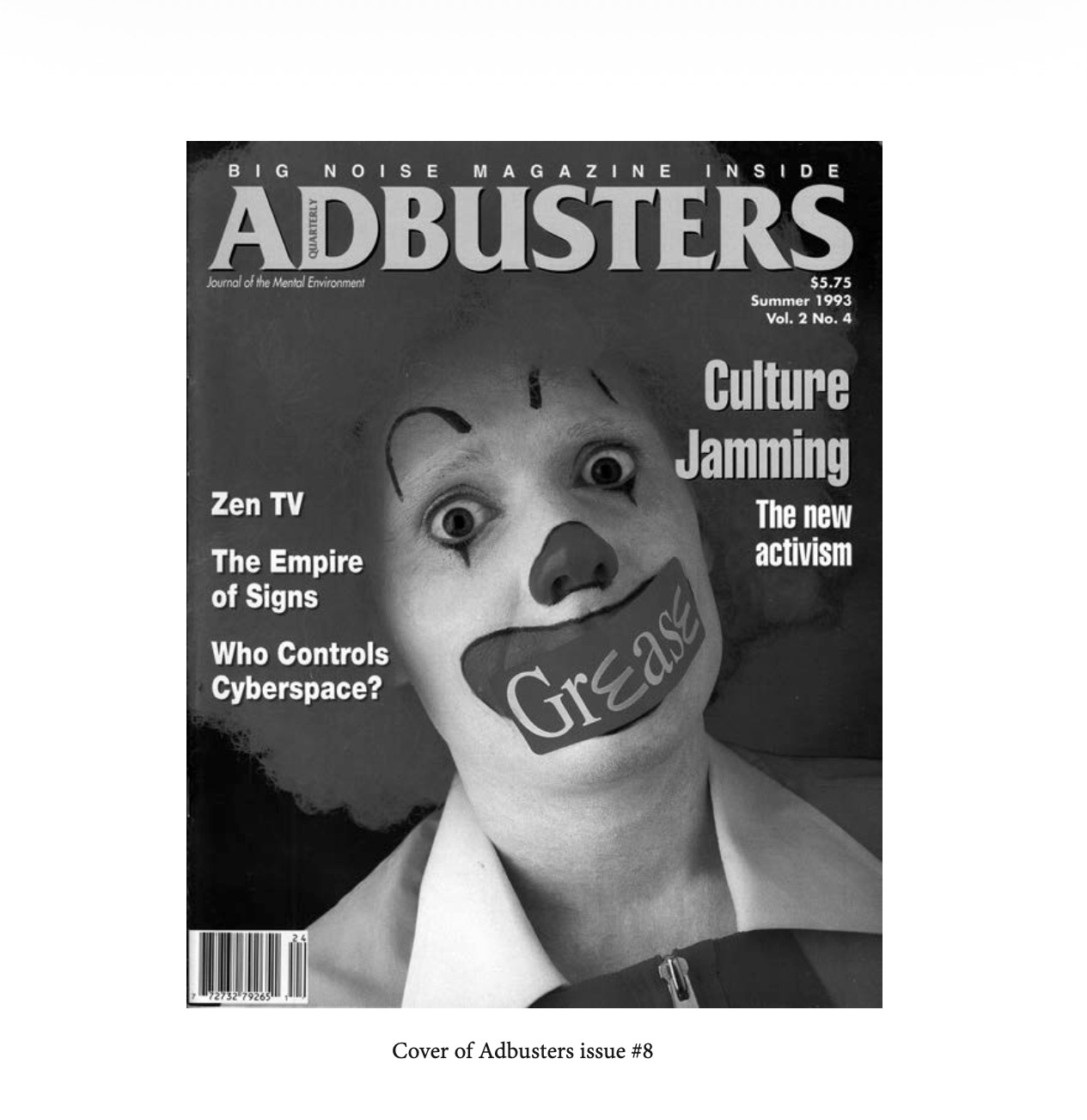
We then produced a flurry of 30-second TV spots. First we called them “anti-ads,” then “uncommercials,” then “subvertisements,” and finally “mindbombs.”
In our meetings, we plotted a full-fledged onslaught against the corporate advertising machine. We wanted to turn television into a battleground of competing narratives; fight an all-out guerrilla war where our mindbombs are constantly popping up all over the TV mindscape, neutralizing the corporate pro-consumption agenda. We thought that this kind of meme war would capture the imagination of the world, and we were confident that in the end, we would emerge triumphant.

We published a book called Culture Jam, which skirted the bestseller lists alongside Naomi Klein’s No Logo. The movement took off. At its peak, the term became a meme in itself. “The studio for the cultural jammer is the world at large,” the great experimental musician Don Joyce put it, and you saw that playing out big-time. People scribbled over bus-stop ads. They “liberated” billboards. They rubbed out the logos on their clothing and shoes and appliances. High-school teachers had their students make spoof ads and sent them to us.
Jesus, it was fun. We were playing jazz now, becoming a legitimate cultural counterforce. We’d cracked the code! We were doing… something. It was hard to tell exactly what. Or for whom. But it was exhilarating suddenly to be standing toe to toe with corporate execs and sometimes landing a punch.
Like satire, culture jamming only seemed light-hearted. Underneath, for many of us, it was serious business about who creates culture. Will culture be spoon-fed to us top-down by corporations, or will we the people generate it from the bottom up?
By now advertising had mushroomed into a trillion-dollar-a-year industry, pumping hundreds of pro-consumption messages into our brains every day, colonizing every bit of literal and figurative space. Product placement in movies sparked outrage at first, but then became ho-hum invisible. Ads popped up in video games, golf holes and referees’ armpits. Companies paid kids to carve their logo into their haircuts. One company wanted to put brand logos in space next to the moon. Advertising was transforming authentic culture into commercial culture and citizens into consumers.
We circled back round to Nike. We had a special beef with these guys. Paying millions of dollars to sports celebrities to dispense bogus cool to teenagers: that is graceless behavior.
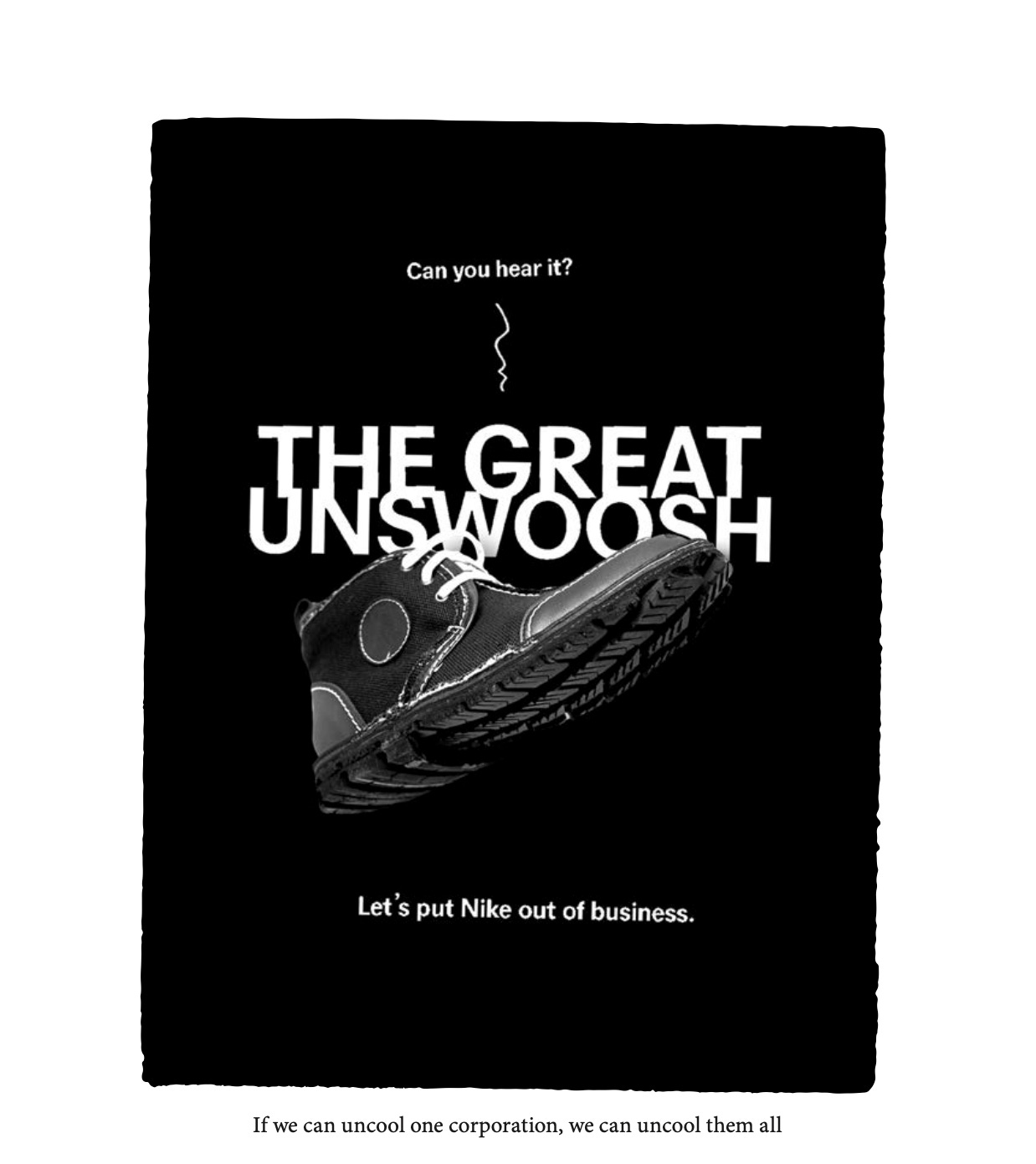
Nike would be a test case for a new move. We wanted to take on one of the giants not just in the marketplace of ideas but in the marketplace of… stuff. So we started our own shoe operation. The Blackspot Unswoosher: the take-no-prisoners pirate shoe, which we had ethically made in Portugal. We think our brand can beat your brand. Of course, Nike sold way more Air Jordans than we sold Blackspots. But then again, we weren’t really interested in market share.
If our Blackspots could take even a fraction of a percent of business from Nike, then we’d have set a precedent that would inspire business- minded social activists to get involved in other areas — to become a virus at the heart of corporate capitalism.
We declared the Blackspot to be an open-source brand. Uncopyrighted and uncopyrightable. We wanted a nimble new breed of entrepreneurs to rise up — we called them “antipreneurs” — to launch Blackspot Coffee shops (with books & music, part library, part meeting place, part altar to caffeine). We wanted to revive the proud underground tradition of coffee shops as incubators of dissent.
We’d sell fair-trade, organic coffee — revolution in every cup — and gradually push Starbucks out of our neighborhoods in the bargain.
We dreamed of a chain of Blackspot restaurants, selling only locally sourced food (a slow surprise in every bite), so tasty and easy they’d chase McDonald’s out of the dinner plans of even the most harried parents.
We saw a world with Blackspot Cola, Blackspot Water, Blackspot Apparel, Blackspot Books, Blackspot Music labels. You’d even be able to get a Blackspot loan. It was anticapitalism in capitalist overdrive — all the profits plowed back into community projects. If you gave capitalism a conscience, this is what it would look like: small trumps big, local beats global, and shared, open-source brands roll over jealously guarded copyrights. Bit by bit, industry by industry, our little Blackspot would reverse capitalism’s top-down dynamic and change the way people lived their lives.
Looking back, that level of idealism seems almost crazily naive. But that’s also what was great about it. We didn’t second-guess ourselves. Didn’t get swamped by existential angst and the impossibility of pulling much of it off. We just reveled in the fuck-it-all spirit of it all.
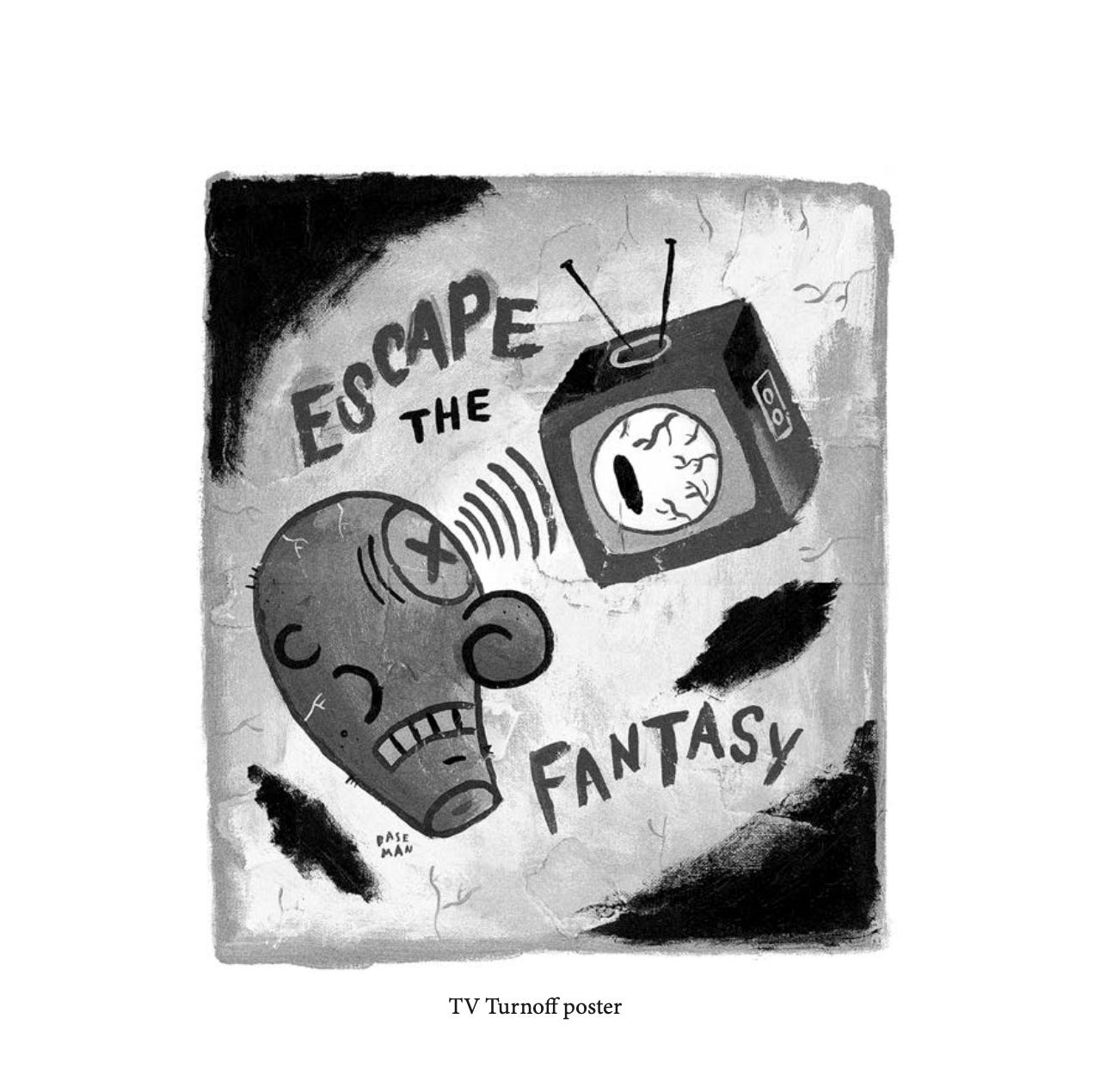
These days, when network TV is pretty much a trifle in most people’s lives, it’s easy to forget how much power the networks once had over us. Television was the circulation system of the culture in the same way the Internet is now. For us, it was the holy grail. We’d get the leverage there to break the hold that advertising-driven culture had on us. We’d slip our mindbombs in there and fight a meme war. Put cultural power back into the hands of the people.
But something happened on the way to the revolution.
The TV stations refused to sell us the airtime. I had many angry phone calls with them, but there was no way they would take our few thousand dollars and risk angering their million-dollar sponsors.
The ABC network’s commercial clearance boss Art Moore was defiant. “There’s no law that says we have to air anything,” he shouted at me on the phone. “We’ll decide what we want to air or not.” NBC’s Richard Gitter said, “We don’t want to take any advertising that’s inimical to our legitimate business interests.”
And Robert Lowery at CBS finally put it straight about our Buy Nothing Day spot. “This commercial . . . is in opposition to the current economic policy in the United States.”
An eerie sense of déjà vu set in. I was born in Estonia where during Soviet rule people were not allowed to speak against the government. There simply were no media channels for debating controversial public issues because the government did not want such discussion to take place. And here I was 50 years later in “the
land of the free” and there was a lack of media space in which to challenge corporate agendas — you were not allowed to speak out against the sponsors.
We spent over $100,000 fighting a legal action against the Canadian Broadcasting Commission (CBC), arguing that every citizen has the right under the Canadian Charter to walk into their local TV station and buy 30 seconds of airtime for a message they believed in. The CBC fought us tooth-and-nail asking for ourcase to be dismissed. After 10 years of legal wrangling, the British Columbia Court of Appeal finally gave us a tiny opening. They ruled that Adbusters Media Foundation did indeed have a legitimate freedom-of-speech case under the Canadian Charter of Rights, and our legal action should be allowed to proceed. But by that time, we could no longer afford to pay the lawyers their $650-per-hour fees. We were exhausted and broke. Our dream of duking it out with megacorporations on commercial television was fading.
But it turns out that nothing is more tantalizing than something you aren’t allowed to get your hands on. People wanted to see the banned ads, to know why they were rejected. Our culture jamming mindbombs began to circulate like wildfire.
And we made a lot of people question what television, the most powerful social communications medium of that time, was really all about if citizens can’t buy airtime under the same rules and conditions as corporations do. After all, doesn’t Article 19 of the Universal Declaration of Human Rights clearly state that: “Everyone has the right . . . to freedom of opinion and expression; this right includes . . . the right to seek, receive and impart information and ideas through any media and regardless of frontiers”?
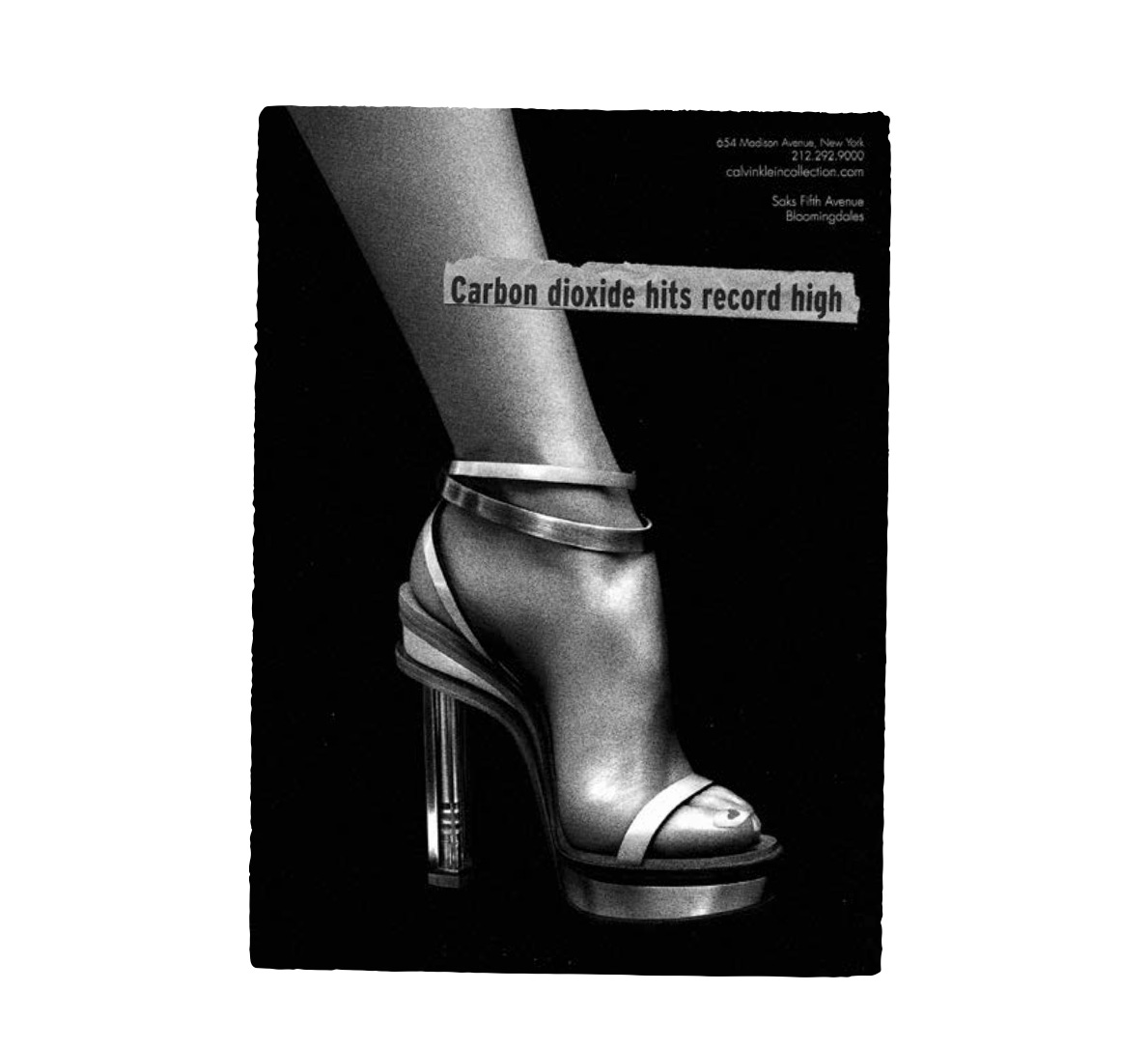
When you google “culture jamming,” it’s sometimes represented as a fad. Something that flared brightly for a decade in fin-de-siècle America. It was everywhere and then it was nowhere. Why? Was it because the TV networks refused to run our ads? Or because we lost our First Amendment legal battle? Or because the corporations themselves pivoted, dropping those monolithic, years-long campaigns that offered up such fat targets, in favor of quick-and- dirty hits tailored to the Internet age? Or maybe it was because culture jamming, for all its cheeky verve, wasn’t actually solving anything. That’s what some folks said. We set ourselves up as aresistance community seeking to discredit and devalue consumerist culture and corporate rule, but at its core our jamming was better at tearing things down than building things up. We were vehemently anti-something, but not really pro-anything. We weren’t able to articulate a set of values, meanings and alternate ways of seeing and talking about the world — which is what any successful oppositional culture must learn to do.
I don’t entirely buy that.
Here’s what I think happened to culture jamming: it never actually went away. It just evolved from a ruckus on the fringes of mainstream culture to part of mainstream culture itself. We are all culture jammers now. Everybody on social media is a cultural warrior. The Net is the jam. It scatters pulses of meaning and sends them on a collision course with other pulses.
Meme warfare is the next evolutionary phase of the people’s resistance. This is where our metameme insurrection will take place.
This is where the planetary endgame will be won or lost.
Aaaagh what an awesome piece! I am so glad you're here.
why are you against alcohol and tobacco? they didn't cause climate change and are relaxing. what we all need nowadays 🦄